
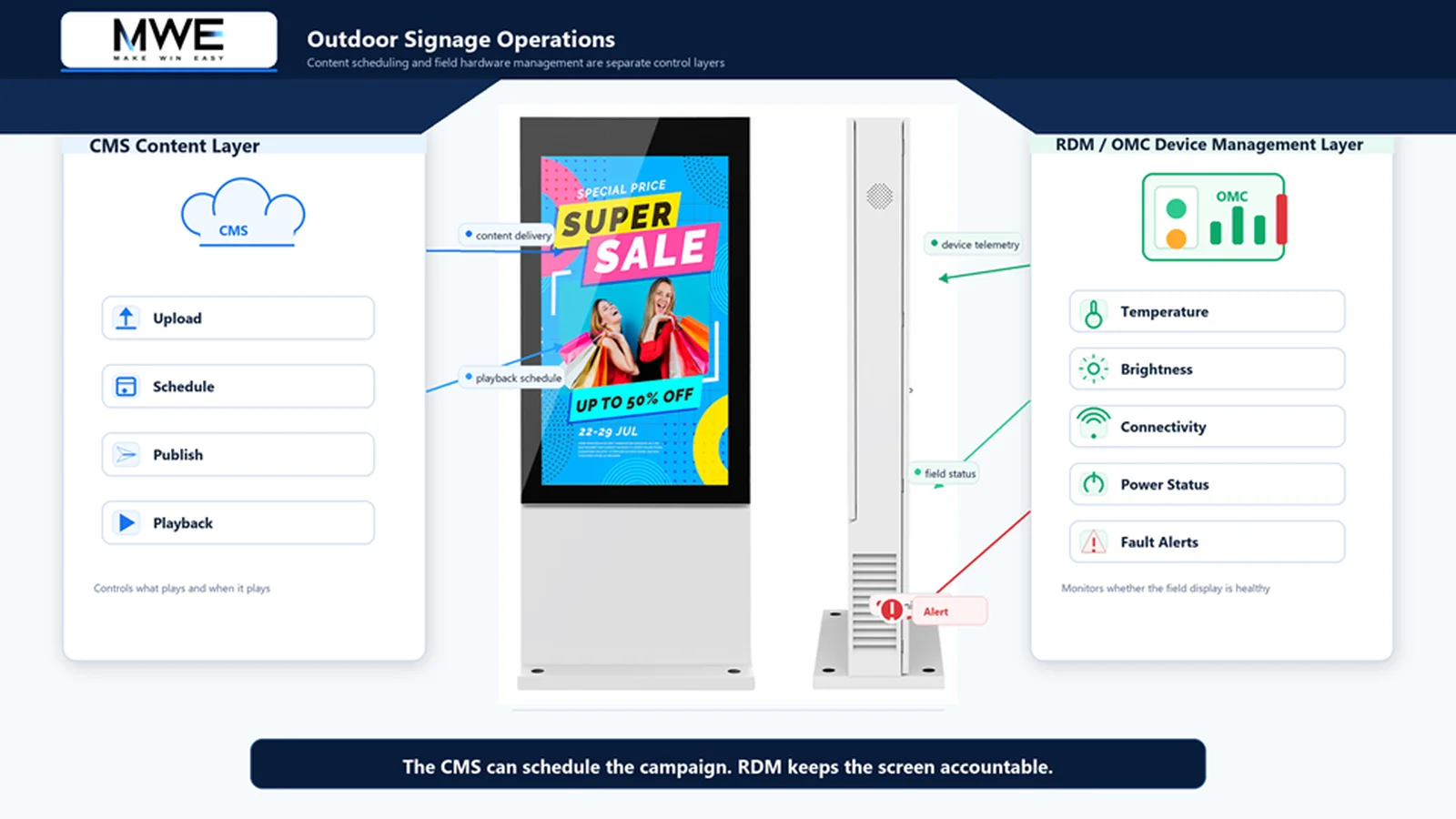
“It supports a third-party CMS” sounds reassuring in a proposal. It is also too vague to protect a rollout.
A commercial display project can pass a showroom demonstration and still fail during deployment because four parties understood the word integration differently. The hardware supplier may mean the screen can accept content from an external player. The CMS provider may mean it can publish through a documented interface. The integrator may assume remote commands are available. The customer’s IT team may expect identity controls, logs, and recovery procedures that no one has actually assigned.
The better buying standard is not a compatibility checkbox. It is a shared integration handoff that shows what has been tested, who owns each boundary, and what happens when the connection stops behaving as expected.
Compatibility Is a Chain, Not a Product Feature
In a real digital signage system, content moves through a chain: authoring, scheduling, transport, playback, display control, monitoring, and support. A failure at any link may look like “the screen is down” to the person standing in front of it, even when the display panel is working normally.
That is why a buyer should separate three questions that are often collapsed into one:
-
Can the planned content reach the playback environment?
-
Can the planned system control or monitor the exact display model?
-
Can the operating team identify and recover the failed stage?
The answers may come from different vendors. A CMS can manage playlists without controlling display settings. A display can expose operational data without giving the CMS permission to act on it. A remote device-management layer can report an abnormal state without knowing whether the content schedule is correct.
MWE’s documented scope includes commercial-display hardware together with CMS and remote device-management capabilities. That establishes a relevant operating territory, but it does not prove that every MWE model exposes the same interface or works with every external platform. The project still needs model-specific evidence.
Put the Four Parties on One Boundary Map
The most useful pre-procurement document is a one-page responsibility map shared by the display supplier, CMS provider, integrator, and customer IT owner.
For each operating task, name one responsible party and one evidence source. Who provisions the device? Who creates credentials? Who publishes content? Who changes configuration? Who receives alerts? Who can retrieve logs? Who decides whether the issue belongs to hardware, software, network, or content operations?
This exercise often reveals problems before any code is written. Two vendors may both assume the integrator owns authentication. The integrator may assume the customer has already approved outbound network traffic. IT may assume the vendor will retain audit logs. A responsibility map turns those assumptions into questions while they are still inexpensive to resolve.
It also prevents a familiar escalation loop: the CMS team can see the server, the hardware team can power on the display, and the integrator cannot show what happened between them.
Make Every Interface Claim Specific
“API available,” “MQTT supported,” and “OAuth enabled” are not complete integration statements. Each term describes a family of technical behavior, not a finished project contract.
OAuth 2.0, for example, defines distinct roles and authorization flows. Naming the standard does not tell a buyer which flow is used, who issues credentials, which scopes exist, how tokens are revoked, or whether the planned client is allowed. MQTT 5.0 defines detailed session, message, and error behavior. Saying “MQTT” does not identify the version, topics, quality-of-service choices, retained-message behavior, or what the device publishes.
This does not mean every project needs OAuth or MQTT. It means that when a proposal names a protocol or interface, the handoff should record the exact model and software version, interface version, authentication method, supported commands, data fields, rate or session limits, error responses, and change policy.
NISTIR 8259A offers a useful due-diligence vocabulary for connected devices: identification, configuration, data protection, interface access, software update, and cybersecurity state awareness. It is not a certification checklist for an MWE product. It is a reminder that an integration affects more than content delivery; it also affects who can identify, configure, update, and observe a device.
Design the Failure Conversation Before Go-Live
Most integration documents describe the success path. Operations teams need the failure path as well.
What happens when the CMS is reachable but the display is not? What if a command is accepted but not executed? What if monitoring data arrives late? What if the display is online but the scheduled content is wrong? What evidence distinguishes a network block from an expired credential, an application error, or a device state issue?
For each realistic exception, record four things: the first observable symptom, the authoritative log or status source, the first responsible party, and the escalation threshold. The goal is not to predict every possible failure. It is to prevent the first hour of an incident from being spent discovering who has access to the evidence.
A simple installation with a vendor-approved player and no remote control may need a lighter handoff. A multi-site estate with external CMS, monitoring, role-based access, and service commitments needs much more. The documentation should follow the operating risk, not a generic template.
Turn Acceptance Testing into Project Evidence
The final handoff should be a witnessed test on the actual display model, planned software versions, and production-like network rules. A lab test on different hardware or an unrestricted network can answer useful questions, but it cannot close the project-specific compatibility claim.
The test record should show the starting configuration, actions performed, commands or content sent, device responses, timestamps, failure simulations that were approved, recovery behavior, and the names of the people who accepted the result. If a requirement cannot be tested before purchase, label it as an open dependency rather than converting it into a promise.
This is where project-grade delivery becomes visible. It is not the confidence of saying that systems “should work together.” It is the discipline of narrowing the claim to a defined configuration and preserving evidence that the operating team can use later.
A Better Question for the Buying Team
No handoff can guarantee that an integration will never fail. Interfaces change, network policies evolve, credentials expire, and operating teams make changes after go-live. The handoff does something more practical: it makes the boundary observable and the recovery responsibility explicit.
Before approving a display-and-CMS package, ask one question of all four parties:
Can you show what happens before, during, and after the connection fails—and who owns each step?
If the answer lives in four separate proposals, bring the display supplier, CMS provider, integrator, and IT owner into one review. Complete the shared integration handoff before the order becomes a live operating problem.